
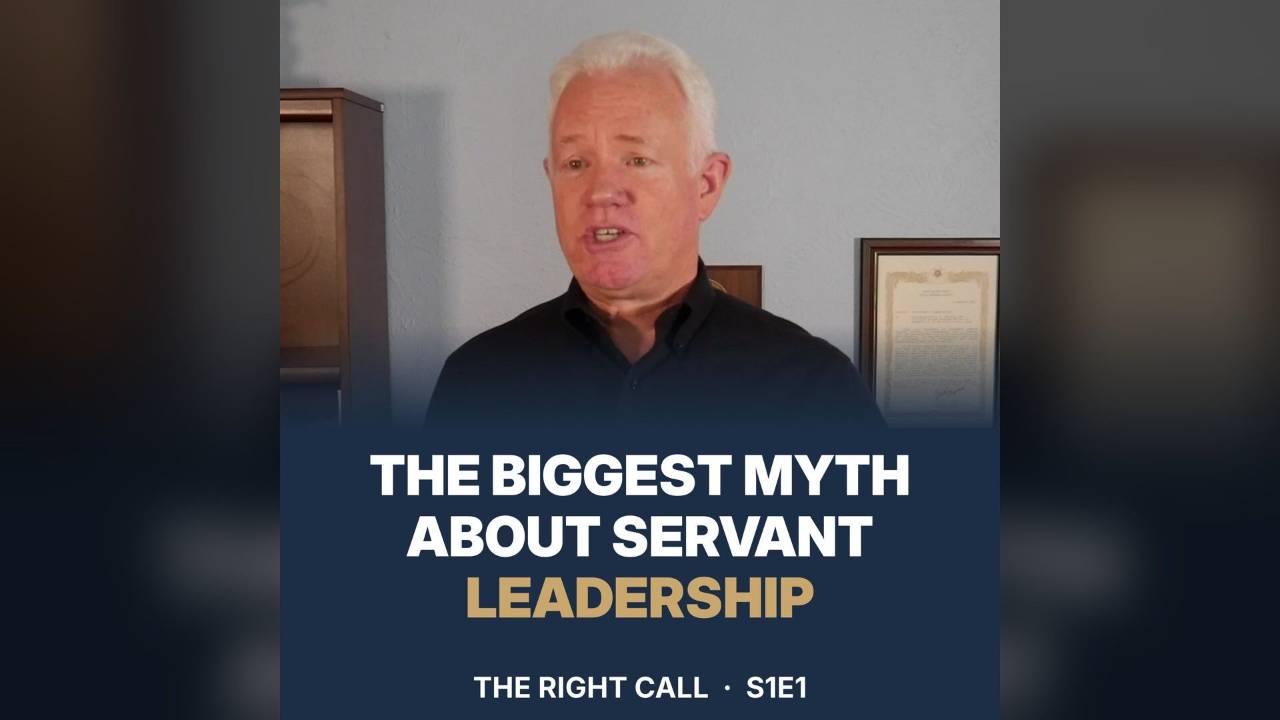
The Biggest Myth About Servant Leadership | The Right Call S1E1
Oct 06, 2026The number one mistake nearly every Christian leader makes about servant leadership? We think it's based around one foot-washing event that demonstrated His humility. Lowering Himself. Putting others first. It sounds right, doesn't it?
What most of us miss — Jesus washed His disciples' feet one time — after three years of leading, training, and challenging them. Foot-washing was never the model. It was a moment in His mission.
Where the modern version came from
When we trace modern servant leadership back to its source, we don't land in Scripture. We land in a 1932 novel by Hermann Hesse, Journey to the East, where a servant named Leo sustains a band of travelers, disappears, and the group falls apart. Leo had been the leader all along.
That story shaped Robert K. Greenleaf, a longtime AT&T executive, who wrote "The Servant as Leader" in 1970. The servant leader, he said, is servant first; then conscious choice brings one to aspire to lead. Later, Larry Spears distilled ten characteristics from Greenleaf's work: listening, empathy, healing, awareness, persuasion, conceptualization, foresight, stewardship, commitment to the growth of people, and building community.
Those are valuable traits, but notice where the weight sits: relational harmony, emotional support, follower well-being. When those become the whole definition of leading, decisions start running through "How will they feel?" instead of "Does this serve the mission?" Teams get stuck in nice mode. Leaders absorb everyone's emotions, shield the team from every consequence, and burn out. It's the difference between training runners and carrying them. One builds speed and endurance. The other never learns to run, and we eventually collapse under the weight.
Leadership is more than taking care of the people in our charge. Caring for our people is a priority, but it is not the priority. Leadership is actually being in charge.
A ship that turned around
I saw the better way on board USS Blakely. We'd failed a major engineering inspection badly. When we pulled into Newport, our new group commander stood on the pier, looked at the rust streaking down the side, and shook his head. We looked like a bunch of pirates who'd captured a U.S. warship.
The next day a lieutenant commander from the group staff showed up and said, in effect: "My boss sent me here for one thing — to get you ready to pass this inspection. I've done it with five other ships. Do what I ask, and you will pass." When the captain or XO tried to pull him onto their pet projects, he said no. He was there for this one thing.
Two months later it was a different ship. Morale was the best I'd ever seen. We passed with flying colors, and for the next two and a half years, with a third of our crew gone, we won every competitive event we entered. We had a leader who served the mission, and as a result, the mission served the people.
What Jesus actually modeled
Jesus lived from a servant IDENTITY first. He said He did nothing on His own and sought not His own will, but the will of Him who sent Him (John 5:30, 6:38). Leadership flowed only as the mission required. He healed, He sent, He taught obedience, He confronted Pharisees and disciples. It was never people first at the mission's expense. "The Son of man came not to be served, but to serve, and to give his life as a ransom for many" (Matthew 20:28).
The foot washing wasn't a leadership lesson. After three years of watching Him feed thousands, calm storms and raise the dead, the disciples had forgotten He was a servant. He was reminding them: no matter how much power you're given, you're still a servant.
This week
- Before the next hard decision, ask "Does this serve the mission?" before "How will they feel?"
- Look for one place where we're carrying someone who needs to be trained to run.
A question to sit with
Am I serving the mission, or quietly carrying the team?
This is Episode 1 of The Right Call: Wisdom Simply Applied.
Author
